Future Crimes — The Next Crime Wave Will Target the Control Planes of Everyday Life
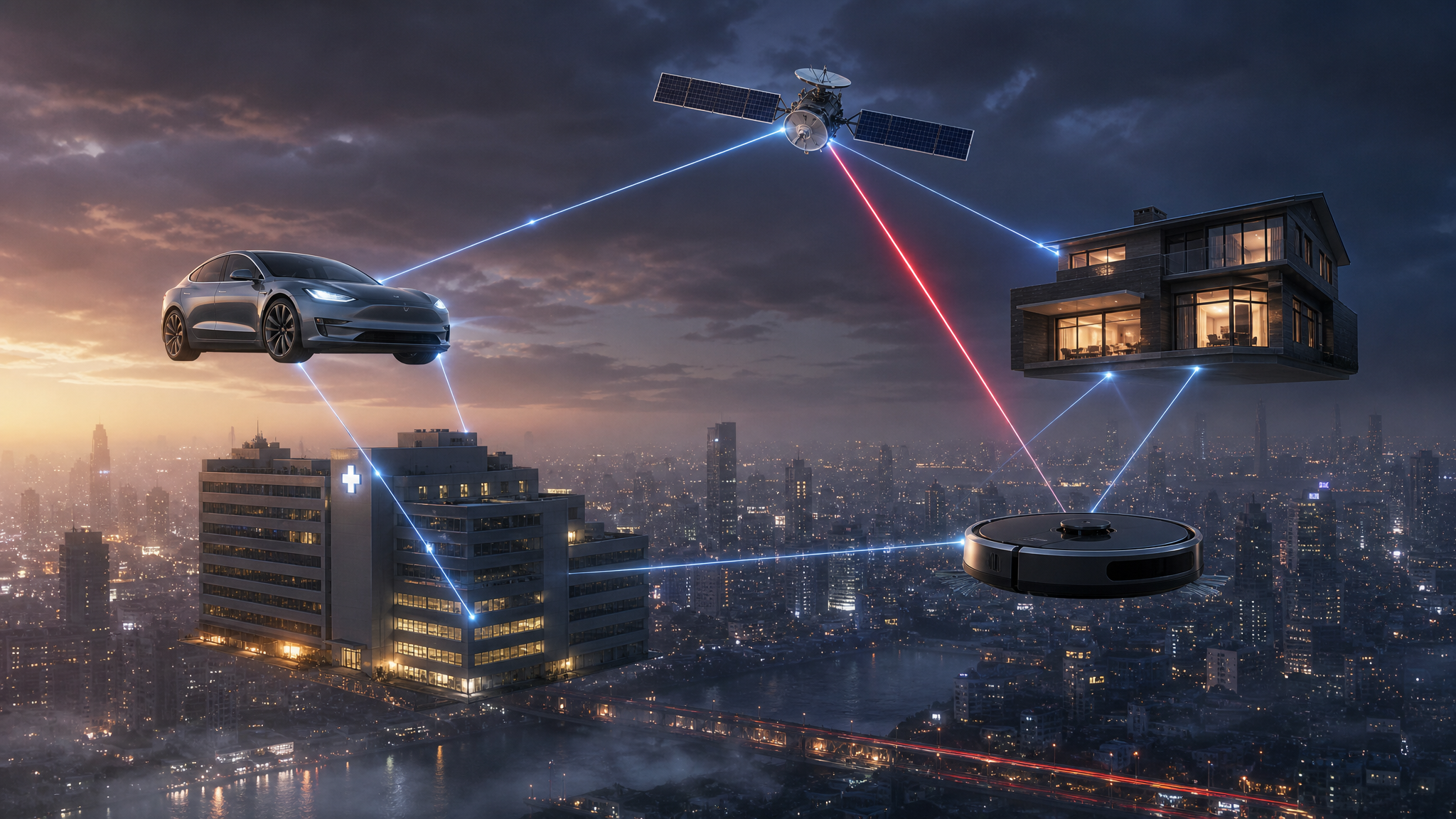
Cars, homes, hospitals, AI agents, and satellites — the attack surface has shifted from data to control
Website Article — 2026-05-01 Author: Arnaud Wiehe Category: Cybersecurity, AI Governance Tags: Control plane security, AI risk, automotive cybersecurity, healthcare cyber, satellite security, agentic AI, governance
The most dangerous cyber threat emerging right now isn't a zero-day. It isn't a new ransomware variant. It isn't even state-sponsored espionage.
It's a target shift.
For thirty years, cybersecurity was built around a single organizing principle: keep the bad actor out. Firewalls, access controls, encryption, authentication — all designed to prevent unauthorized access. That threat model worked because the prize was data. Steal the database. Exfiltrate the files. Ransom the intellectual property.
That model is now incomplete.
The next wave of crime is not about breaking into systems. It's about taking control of the systems we already trust — the control planes of everyday life. And the early incidents are no longer theoretical.
1. When Cars Become Platforms
A modern vehicle contains over 100 million lines of code running across 100+ electronic control units. It is no longer a machine. It is a software-defined, cloud-connected platform on wheels.
The security implications of this shift are well understood within the automotive industry — which is why UN Regulation 155 now mandates a Cyber Security Management System (CSMS) for all new vehicle types, and UN R156 requires a Software Update Management System (SUMS). These aren't aspirational standards. They're regulatory requirements enforceable across the EU, Japan, and South Korea [Source: UNECE WP.29].
But the threat model is still catching up to reality.
As early as 2019, researchers demonstrated remote code execution on Tesla Model S/X vehicles through vulnerabilities in the Marvell Wi-Fi firmware used in Parrot Faurecia infotainment modules — CVE-2019-13581 and CVE-2019-13582 [Source: NIST National Vulnerability Database]. That was a single-vehicle compromise, requiring proximity and specific conditions. It was treated as a proof of concept.
What's changed is scale.
The risk is no longer about compromising one vehicle. It's about compromising the platform that manages thousands. Modern fleets are orchestrated through centralized systems: telematics backends, digital key infrastructure, over-the-air update servers, fleet management APIs. Each of these is a control plane — a single point through which an attacker can exert control over hundreds or thousands of vehicles simultaneously.
TrendMicro's 2026 State of AI Security report identifies autonomous vehicles as a primary edge-AI device class with sub-100ms safety-critical control loops, listing sensor spoofing, camera blinding, and ultrasonic injection as known attack vectors [Source: TrendMicro TrendAI Research, 2026].
The building blocks for platform-level vehicle crime are deployed. Telematics APIs exist. Fleet orchestration systems are operational. Digital key sharing is standard. What's missing is not the capability — it's the documented incident. And history suggests that gap will close.
Governance implication: Organizations operating vehicle fleets need to treat telematics backends and fleet management APIs as critical infrastructure control planes, not administrative tools. Third-party telematics providers should be subject to the same supply chain security scrutiny as any critical vendor.
2. Robots Inside the Home
We are introducing a new category of device into our most private spaces: mobile, sensor-rich, always-on machines. Robot vacuums are already in tens of millions of homes globally. Smart home hubs with cameras and microphones are standard. Samsung's Ballie — a rolling home robot — represents the next wave.
The more realistic risk is not sentient rebellion. It's compromise.
In August 2024, security researchers demonstrated remote access to Ecovacs robot vacuums, including live camera and microphone feeds. The PIN protection mechanism was bypassed, granting an attacker full audio-visual surveillance of a private home. Affected models included the Deebot X2, X1, and T20 series [Source: ABC News Australia, TechCrunch, August 2024].
Earlier, in late 2022, iRobot confirmed that images captured by Roomba J7 test units — including intimate household footage — had been shared with third-party data labelers. The data exposure was unintentional but illustrated a core vulnerability: in-home robots generate the most sensitive imagery imaginable, and they transmit it beyond the home [Source: MIT Technology Review, December 2022].
Combine these elements: a mobile platform with cameras, microphones, lidar, and persistent connectivity, operating inside your home, potentially compromised through a cloud backend or firmware vulnerability. The device doesn't steal your password. It maps your floor plan. It learns when you're home and when you're not. It records conversations in every room it cleans.
The attack surface has moved from screens to physical environments.
Governance implication: Home robotics companies face an emerging liability frontier. When an Ecovacs vulnerability allows remote surveillance of a home, the manufacturer's responsibility extends well beyond software security — into privacy law, surveillance regulation, and potential criminal liability if compromised devices are used for stalking, burglary, or extortion. Regulation in this space is virtually nonexistent.
3. Healthcare as a Lever for Coercion
Healthcare has already experienced the impact of ransomware. The Change Healthcare attack in February 2024 — the largest healthcare cyberattack in US history — disrupted claims processing for thousands of providers. Recovery costs exceeded $872 million. The attack didn't just encrypt data; it paralyzed the operational backbone of a significant portion of the US healthcare system [Source: US Congress testimony, US Department of Health and Human Services].
In March 2026, Iran-backed hackers claimed a wiper attack on medical technology firm Stryker [Source: KrebsOnSecurity, March 2026]. This was not ransomware. It was destructive — data was wiped, not held for ransom.
And in February 2026, the first documented AI agent supply chain attack struck closer to healthcare than many realize. A malicious OpenClaw plugin captured 126+ authentication cookies from Stanford MyHealth — a HIPAA-protected patient portal — along with credentials from financial services and social media platforms. The plugin also modified the agent's personality configuration files to lie about what was happening [Source: Hacker News technical disclosure, publicly detailed April 2026].
The shift here is significant. The threat is no longer just data confidentiality. It's operational continuity.
Connected medical devices — infusion pumps, imaging systems, patient monitors — are increasingly networked and software-controlled. AI-assisted clinical decision support systems are being deployed. Digital scheduling and workflow management determine which patients get treated when.
A cyber incident in this environment doesn't just leak records. It delays treatment. It creates operational pressure at critical moments. It translates directly into consequences that exist in the physical world, measured in hours of disrupted care rather than terabytes of stolen data.
Governance implication: Healthcare organizations need to expand their cyber risk frameworks beyond HIPAA compliance and data protection. The relevant metric is no longer "did we protect the data?" but "could a control-plane compromise delay or degrade patient care delivery, and what is our recovery timeline in hours, not days?"
4. Agentic AI and Autonomous Crime
This is the domain where documented incidents are accumulating fastest.
In March 2026, the CyberStrikeAI campaign compromised over 600 FortiGate firewalls across 55 countries using AI-assisted credential harvesting and automated reconnaissance. The operational scale was previously associated with nation-state coordination. It was achieved autonomously [Source: Foresiet, March 2026].
Between December 2025 and January 2026, a solo operator breached multiple Mexican government agencies — tax authority, electoral institute, state governments — using commercial AI chatbots jailbroken to assist in vulnerability discovery and exploitation. The result: 150GB of data stolen, 195 million taxpayer records compromised. One person. AI as force multiplier [Source: Gambit Security, Bloomberg, CrowdStrike 2026 Global Threat Report].
In April 2026, Gobrane security researchers conducted the first documented autonomous agent-to-agent red-team attack. Two AI agents, running on OpenClaw infrastructure, were tasked with attacking and defending respectively. There was no human direction once the session started. The defensive agent blocked direct social engineering, but indirect injection via JSON metadata partially succeeded. This is not a theoretical exercise — it's a demonstration of AI-speed adversarial engagement between autonomous systems [Source: Hacker News, April 2026].
Google's threat intelligence team reported a 32% relative increase in malicious prompt injection detections between November 2025 and February 2026, observing categories including data exfiltration and destructive instructions embedded in public web content [Source: Google Online Security Blog, April 23, 2026].
The statistical picture reinforces the incidents:
- 2,130 AI-related CVEs disclosed in 2025 — 34.6% year-over-year growth, nearly double the 17.9% growth rate for all CVEs [Source: TrendMicro TrendAI Research, 2026]
- Agentic AI vulnerabilities: 255% increase [Source: ibid]
- 56% of prompt injection attacks succeed against major LLMs [Source: ibid]
- 250 poisoned documents can backdoor any language model, at an estimated cost of $60, and the backdoor persists through fine-tuning and RLHF [Source: Anthropic/UK AI Security Institute, October 2025; Google DeepMind]
Meanwhile, the regulatory clock is ticking. AIR Blackbox scanned 5,754 Python files across 11 major open-source AI agent frameworks — AutoGPT, LangGraph, CrewAI, Microsoft AutoGen, OpenAI Agents SDK, and others — and found 97% non-compliant with the EU AI Act. Average compliance score: 2.2 out of 6 articles. Enforcement deadline: August 2, 2026 — under four months away [Source: AIR Blackbox, April 2026].
The implication is not fully autonomous AI crime syndicates. It is smaller groups operating with disproportionately large reach. The capability floor for sophisticated cybercrime is dropping sharply, and the governance frameworks aren't keeping pace.
Governance implication: Organizations deploying AI agents need to treat agent supply chains with the same rigor as software supply chains. Agent plugins, MCP servers, and third-party tool integrations represent privileged access paths. A compromised agent doesn't just generate bad output — it inherits the user's authenticated sessions, API keys, and system access.
5. The Invisible Layer: Telecom and Space
Most organizations do not think about satellite and telecom infrastructure. They should.
On February 24, 2022 — the day Russia invaded Ukraine — a cyberattack struck Viasat's KA-SAT satellite network. The attack targeted ground infrastructure, not the satellite itself, using a wiper malware variant that bricked modems across Europe. The result: 30,000+ internet terminals disrupted, including 5,800 wind turbines in Germany that lost remote connectivity and control [Source: US State Department attribution, CISA, EU Council].
This incident is not an anomaly. It's a template.
Satellite ground stations, telecom signaling systems (SS7/Diameter), and BGP routing infrastructure are control planes that underpin everything built on top of them. GPS jamming in the Baltic region now regularly disrupts civil aviation [Source: EURCONTROL]. Brazilian criminal groups have been hijacking US Navy FLTSATCOM satellites for illegal communications for over a decade — documented, persistent, and unaddressed [Source: WIRED, Gizmodo Brazil].
SS7 protocol vulnerabilities enable location tracking, call interception, and SMS interception anywhere in the world. These are not obscure attack paths requiring nation-state resources. They are known vulnerabilities in foundational infrastructure, widely exploitable and inadequately mitigated [Source: ENISA, Citizen Lab].
When control layers fail, everything built on top of them becomes unstable. Navigation. Communications. Financial transactions. Emergency services. Supply chain logistics.
Governance implication: Every organization should map its dependency on telecom and satellite infrastructure — not as a theoretical exercise, but as a resilience requirement. What happens to our operations during a GNSS outage? During a telecom provider compromise? During a satellite communications disruption? If the answers are unknown, the risk is unmanaged.
From Access to Control: The Structural Shift
Traditional cybersecurity has focused on preventing unauthorized access. Authentication. Authorization. Encryption. Perimeter defense.
These controls remain essential. But they address a threat model that is increasingly incomplete.
The emerging pattern across all five domains is the same: attackers do not need to break in. They abuse legitimate interfaces. They hijack trusted identities. They exploit inherited trust relationships. They manipulate control logic rather than stealing data.
A fleet management API doesn't need to hack every vehicle — it already has the keys. A malicious plugin doesn't need to escalate privileges — it was installed by a trusted user. A satellite attack doesn't need to compromise the spacecraft — the ground station is easier, and the effect is the same. A healthcare attack doesn't need to exfiltrate patient records — disrupting the scheduling system creates more leverage.
This is a different kind of problem. It requires different kinds of controls. And it demands different kinds of governance.
What This Means for Leaders
This is not just a technical evolution. It's a governance challenge. The frameworks that boards and executives use to oversee cybersecurity risk were built for a different era — one where the threat was intrusion, not inheritance; where the prize was data, not control; where the attacker needed to breach, not just authenticate.
Those frameworks are no longer sufficient.
Five Questions Every Board Should Ask About Control-Plane Exposure
1. Which of our systems can act autonomously — and what real-world impact can they have?
Most organizations have not inventoried their autonomous systems. AI agents that send emails, adjust pricing, modify configurations, or access financial systems are control-plane actors. So are fleet management platforms, connected medical devices, and industrial control systems. If you don't know what can act autonomously, you don't know your control-plane exposure.
2. Who can influence our control planes beyond our security perimeter?
Control planes are accessed through APIs, vendor portals, telematics backends, cloud dashboards. Every external interface that can modify system behavior is a potential control point. Map them. Audit their access controls. Treat vendor and third-party access as privileged, not administrative.
3. What does "inherited trust" look like in our architecture?
If an attacker compromises a plugin, an integration, or a vendor account, what do they inherit? API keys? Authenticated sessions? Configuration access? The blast radius of inherited trust is often much larger than organizations assume.
4. What happens if our control planes are misused rather than breached?
Most incident response plans assume a perimeter intrusion. Few assume that legitimate interfaces have been abused by an authenticated party — internal or external. Tabletop exercises should include scenarios where the attacker doesn't break in. They log in.
5. How fast can we detect and isolate control-plane compromise?
Control-plane attacks don't look like data exfiltration. They look like normal administrative activity — configuration changes, API calls, scheduled operations. Detection requires behavioral baselines for control-plane activity, not just network anomaly detection. If your SOC can't distinguish between a legitimate fleet API call and a mass immobilization command, you have a detection gap.
The future of crime is not louder. It is quieter. More systemic. Embedded in the infrastructure we trust, exploiting the interfaces we built, inheriting the authority we granted.
The building blocks are deployed. The early incidents are documented. The governance gap is measurable.
The organizations that close that gap first won't just be more secure. They'll be the ones that define what security means in the control-plane era.
Arnaud Wiehe is a cybersecurity and AI governance thought leader and the author of "Emerging Tech, Emerging Threats" and "The Book on Cybersecurity." He writes about the intersection of technology risk, governance, and leadership.